Johann Peter Peetz
Johann Peetz lived a full but short life encompassing much of the last half of the 19th century. He was born into a farm family in a small village of Dollendorf in the western most portion of what would become the country of Germany. When he was born Dollendorf was a village of nearly a thousand in the district of Westphalia. By the time he died on the other side of the world in Sidney, Nebraska, in the relatively new country of the United States, his home village had become successively part of the Prussian Empire and then the German Empire. He fought gallantly for the Prussian empire in two of the many 19th century European wars to establish that empire and then emigrated to the United States to “prevent his sons from dying in continual wars” as he related to his wife. Interestingly enough, his son and namesake, John Sr. was to join the American cavalry in the new country and his son, Johann’s grandson and namesake and our father, was to return 75 years later as a tail gunner in a American B-17 bomber to be part of a World War to destroy what that German empire had grown into. Johann would not live to see any of this, dying of esophageal cancer at the young age of 53 after establishing the Peetz family in America on land he homesteaded.
He was by trade a carpenter and the son of a farmer and sexton and would use both of those skills on the land he homesteaded in Cheyenne County, western Nebraska in the last two decades of the 19th century. He served two different terms as a soldier in an elite unit for the Prussian army. He was awarded a medal for his service in the Austrian Prussian war of 1866 and then returned to serve as a commando in the Franco-Prussian war. During that war, in the siege of Paris he was reputed to have served as a spy, traveling into Paris to obtain information for the army. He likely spoke French as well as German having grown to manhood in a part of Europe that has been contested by the various Germanic states and France for almost a thousand years.
It is hard for those of us growing up in the last sixty years to think of Germany as a weak country, having seen the history of the two great wars and now the overwhelming presence of Germany in the European Union. However, Germany, as we know it, is almost two hundred years younger than the United States. Geographically, Germany is situated in the middle of Europe on flat river valley and has no natural defensive physical borders to either migration or invasion. It can be divided into three different landscape zones starting at the flat northern plains from the North Sea and extending into the southern alpine region. From north to south the terrain changes from marshland to dense forest and then to the Alps. One of the mountain ranges in the south is the Eifel and in this region sits the small town of Dollendorf. Germany itself, despite an out sized role in world history is only about the size of Montana but has three great rivers, the Rhine, Elbe and Danube, running through it.
In ancient times this land was settled and conquered by many tribes from the north as well as the east. The moderate climate and fertile soil attracted peoples as far back as the Neanderthals, cousins of modern day humans who migrated here from Africa. In fact, the name comes from the Neander valley, near Dollendorf, where their remains were first discovered in 1856. They migrated throughout Europe and died out 30,000 years ago. The central location, warm climate and fertile soil remained an attraction and the region was next settled by the Celts who greatly influenced the culture and the language. Julius Caesar and his legions defeated the Celts and his chronicles of the wars are some of the earliest historical writings about this area. Subsequent invasions from the east by the barbarian tribes ultimately settled most of Europe, supplanted the Celts and then repulsed the Roman empire. In 9 CE, these tribes inflicted the worst defeat on the Roman empire in its history and forever altered the makeup of Europe.
These tribes were primarily warrior dominated and more interested in glory and battle than agriculture or establishing settlements. There were many separate tribes who were pushed westward from Asia by climate conditions as well as Mongol pressure from the east and south. The region of central and western Europe was available due to crumbling Roman strength. The tribes shared a common language and heritage but were fiercely independent and often at war with each other. They all shared a warrior culture centered around family and tribe and often brought their family to the battlefield to fight side by side with them. They prided themselves on marriage fidelity and political advancement in the tribe was by achievement and conquest rather than wealth or luxury. This sense of family, duty and honor have been a trademark, sometimes to their detriment, of the German soldier ever sense. Political decisions were made at assemblies during which each warrior was encouraged to speak. By 100 CE most of what makes up modern Germany was settled by several different tribes who lived in harmony, more or less with the Roman empire. They established trading forts along the border and, as the Roman Empire decayed from within, ultimately provided most of its armies as paid mercenaries. The emperors, lacking capital, paid many of the tribes with land grants and subsequently the various tribes came to occupy most all of what had been Rome, from Spain to the North Sea. Initially most of these tribes were pagan but during the 4th century a significant majority converted to Christianity, albeit of the Arian sect which denied the divinity of Jesus and was declared heretical by the Council of Nicaea in 325 C.E.
By the sixth century C.E. the Roman Empire had been transformed into a patchwork of Christianized Germanic tribes who first dominated and ultimately assimilated most of the Romans they encountered as well as all the peoples that the Romans had conquered. Among these tribes were the Franks. In 496 C.E. Clovis, King of the Franks defeated the last Roman army and converted to Roman Catholicism. He founded a dynasty known as the Merovingians who ruled until 752 and conquered most of the tribes in central and eastern Europe and forced conversion to the Latin Catholic Church. By now the Roman Catholic Church had assumed a pre-eminent position in the world both politically and spiritually.
In 752, the Carolingian dynasty was formed by Pepin III, in conjunction with the bishop of Rome and the partnership between the papacy and the political class which was to dominate and determine the next 1500 years was formed.
The greatest of the Carolingians was Charlemagne (742-814) who ruled from 748 until 814 and conquered most of what makes up continental Europe. He fought the Muslims in Spain and in eastern Europe and forcefully converted most of the people and lands in-between. He formed a strong bond with the papacy and was rewarded when he was crowned emperor of the Holy Roman Empire in 800 C.E. He emphasized Roman organization, Christian values and Germanic military organization and allowed local control by regional governors who enforced royal degrees. This was to become the foundation for medieval Europe.
The Franks, like many cultures of the time, practiced partial inheritance, meaning each son was entitled to a piece of the kingdom. Unfortunately, upon Charlemagne’s death this lead to division and ultimately civil war.
In 843 C.E., by the Treaty of Verdun, the kingdom was split between his three grandsons. Charles the Bald received the western part which spoke a different dialect and which became France and Belgium. Louis the German received the eastern portion which included all the lands east of the Rhine, where the language had a more Germanic base and his prodigy ultimately assumed the throne of the Holy Roman empire. The middle of the kingdom and the title as emperor was given to Lothair I and these lands, running from the North Sea to central Italy, were known as Lorraine. Within twenty years the lateral two kingdoms partitioned Lorraine and then proceeded to spend the next 1000 years fighting over it. Dollendorf sits close to the middle of the territory of Lorraine.
There are two documents that Dad and Cindy were instrumental in obtaining from the German relatives. They were then translated by a Ursuline nun who was a friend of Sister Emily’s and spoke German They make for interesting reading and are attached as two appendix.
History of the Parish of Dollendorf
The parish village of Dollendorf lies on an elevated plain about 1600 feet above the North Sea. It is cut through from the street of Hillesum to Ahr Street. In the year 1810, the village counted 617 souls and the entire parish counted 83, including Ahrjuitte, Schlossthol above Vellerhof. Not to mention four Israelites living in the village, Dollendorf makes a good impression. It has good streets and houses built of stone. The area is fruitful. Wheat, rye, spelt (a kind of wheat, used to cultivate improved varieties of wheat), barley, oats, and fruit thrive there. The village is very well known for its handicrafts and musicians, stone builders, cabinet makers, and weavers. It lies in the jurisdiction of Aachen and in the district of Schleiden. It has its own mayor.
The authentic forms of the name (and when they were used I presume) are Dollendorpt, 893; Tollendort, 1140; Dollendorp, 1208; and Dollendorp, 1316.
There are two suggested meanings of the village names. One name, Thaldorf(Dell-Thoal), suggested that it lies on a high plain but also in the valley of the Schrappen Mountains and the Dollendorf Mt. A second possibility is that it comes from the name of the people of Talliaten, who were supposed to be besieged by the Romans and transplanted to the region but who are native to the land of Hungary and may have been a part of the Magyar tribes. (This may explain why like so many people of this region were are less Nordic and more dark German in appearance as the Magyars are dark complexed with black hair and sharp features)
The Romans are supposed to have had a significant settlement in Dollendorf. There are Roman ruins in the area dating back to the first century, including several stones bearing inscriptions. Some of these stones were in a temple dedicated to Mars, the Roman god of war and were later used in the parish church and in the balcony of the original Peetz home. Besides this stone, they found yet another inscribed stone. One has the name of the Consul for the year 182 B.C. (Roman government). Beside it Roman coins were found.
The Lords of Dollendorf
Coat of Arms: An eagle with tournament tilting collar in silver.
The great Roman settlement, whose center we regard Dollendorf, was besieged by the Franks in the 6th Century. There was the opinion that it became the property of a “Great Franconia” who hunted here in the woods and cultivated its land. The first authentic report of a “lord of Dollendorf” we find in the Primer-Guitar register of 893, where under the vassals, a “vir novilis de Dollendorpt” was administered. In the glossary of the Guter register of 1222 we hear that the “Lord of Dollendorf” had a castle. In the following documents, we find reference to the pious sense of the race. As we shall see later, they were often in pecuniary embarrassment.
The history documents ownership of the castle and lands passing back and forth between families, the Church and several countries as was very common in the Middle Ages. By 1810, the castle and villages were in the hands of the French who tore them down leaving only a small village. The stones were used repeatedly in the construction of houses so today many of the houses in Dollendorf have their origin in the castle. The remainder of the circular wall which enclosed big fortified castle stands today even if the castle is gone.It probably had a drawbridge as one can still see the moat. The chapel of the castle was consecrated by St. Nicholas and was there where yet today the remains of the tower stand.
The Parish of Dollendorf
It is supposed that in Dollendorf, the surrounding area the first Christians were in Eiffel. The old temple of Mars is supposed to have been transformed into a Christian church in the time of the French. The Abby Rim already possessed in the 9th century material goods in Dollendorf. In 1201, the counts already had religious people in their families. In 1325 Konrad lord at Dollendorf was a priest here. Because of that it is supposed that Dollendorf was the oldest Christian place in Blankenheim. Like most of Germany the region went through horrific religious wars between the Catholics and Protestants and even amongst individual parishes.
According to the parish archives of Dollendorf, Pastor Nicoli had only a chapel before the 12th century and belonged to the parish of Wiesbaum. At the time the place lay in the neighboring area of Dollendorf and between the 2 places arose a fight as to who should be the parish village. This came to a bitter war. The Dollendorfers were victorious. Ohnhord had at the time 12 houses and Dollendorf had 26. In the wars with the dairy farmers both villages were burnt down. Dollendorf only partially and Ohnhord was never rebuilt. The inhabitants moved to Dollendorf. Still today they call the land between Zwischen den Darfern (between the villages) and in 1320 the new and bigger church was built.
From 900 C.E. until the time of the Reformation the lands that make up Germany and most of central Europe were composed of literally hundreds of small political units consisting of kingdoms, dukedoms, free cities, bishoprics and entities controlled by a strong figure who could be royalty or religious in nature. These individuals, or in many cases, religious orders of warrior knights, would subjugate an area and then rule as feudal overseers. They pledged their loyalty to stronger dynasties and always the Pope and were often at war with neighbors and or former allies. The common people tried to get along as well as possible and suffered with each war. The men were drafted to fight and those left behind, the old, young and women as well as their lands were often ravaged by the armies who all lived off the land. Coincident with this the Black Plague raged across most of Europe starting in 1347 and returning periodically for the next 300 years killing about one third of the population.
By the time of the Reformation in 1521, much of the landmass of modern Germany was composed of small kingdoms under the loose confederation of the Holy Roman Emperor. He had ceded them ever more powers of local rule to secure their loyalty. He was desperate for their support, physically as well as financially in his battles with the other royal houses of the continent and the several, mostly failed, Crusades and now these petty rulers wanted more political power as well. Many chafed at the increasing harsh intervention of a Catholic church which had become more political, temporal and wealthy than religious. Taxation by both crown and church was stifling and the hand that ruled many people was heavy. Furthermore, there had been dramatic positive changes in the educational level of many people strengthened by the printing press and the expansion of university. All of this made the common person less likely to accept at face value the teaching of the Church. German cities and principalities had also seen a rising middle class of merchants and professionals as well as clerics who challenged Church authority.
When Martin Luther published his 95 theses in response to the Medici Pope Leo X who was selling indulgences to raise money to restore St Peter’s Basilica, they went middle ages viral. Luther quickly published and distributed the main concepts which promised salvation on a faith not controlled by the clergy. The population embraced the concepts widely and soon other ministries sprung up, some so radical that Luther was forced to lend support in violent suppression of the new religions. For many reasons the various principalities became Catholic or Protestant and any sense of order quickly evaporated. For the next 100 years, the states fought each other in minor religious wars with long periods of uneasy peace. The guiding principle was that each individual ruler could determine his nation’s faith.
In 1618, the Austrian Catholic rulers tried to force conversion to Roman Catholicism on a newly captured Protestant Prague and the locals revolted. Thus, began the Thirty Years War which involved all the major world powers including Sweden, Russia, France, England and Spain. This war was fought totally on German soil. It is estimated that several million people were killed and whole regions devastated. As many people died during these thirty years as did in the time of the plague. Entire towns and regions were depopulated. One result was mass emigration following this, one part of which was the movement of German families like the Giers and Hardts to Russia at Catherine’s request. A second result was a destruction of many of the minor dukedoms and free cities. Ultimately the Austrians and Prussians absorbed many smaller entities and formed rival confederations of the smaller states. France and Great Britain became the world’s most powerful countries and fought an on again, off again 100-year war which included the French and Indian war in North America and the American Revolution. These wars also drew in the German states and it is estimated that over a million German soldiers from the various states were lost during this period. France degenerated into revolution followed by Napoleon and his continent-wide wars of the early 1800’s, again mostly fought on German soil. Following the Treaty of Vienna in 1814, the European powers and lands were exhausted and devastated. There followed a relative period of peace and rapid population expansion. Prussia lead the way on mainland Germany and rivaled England for world dominance.
Surnames
Much of Europe and Germany in the Middle Ages was by necessity rural, farm and family oriented because the means to grow and store food in any great quantities was still lacking and the urban areas as manufacturing centers were yet in the future. Most people were known only by a first name and a family reference as you can see from the Dollendorf report above. About the start of the 14th century, primarily as the population grew and the concept of individual taxation came about, there was a need for better individual identification. Therefore, people adopted a surname based on location, occupation, body habitus or family. Hence a man of small frame named John who was the baker, and a son of Thomas, could become John Baker or John Small or John Thompson.
In addition, in notes Cindy Taylor recorded from Finding Your Roots, she noted: “the origins of most first names is in the Bible. In 325 AD, the Church outlawed the use of pagan names and later, in 1545, made the use of a saint’s name mandatory for Catholic baptism. As a result, in all the western countries during the Middle ages, there were only about twenty common names for infant boys and girls. Then, as now ( written by Cindy in 1977) John and Mary dominated as the most common.
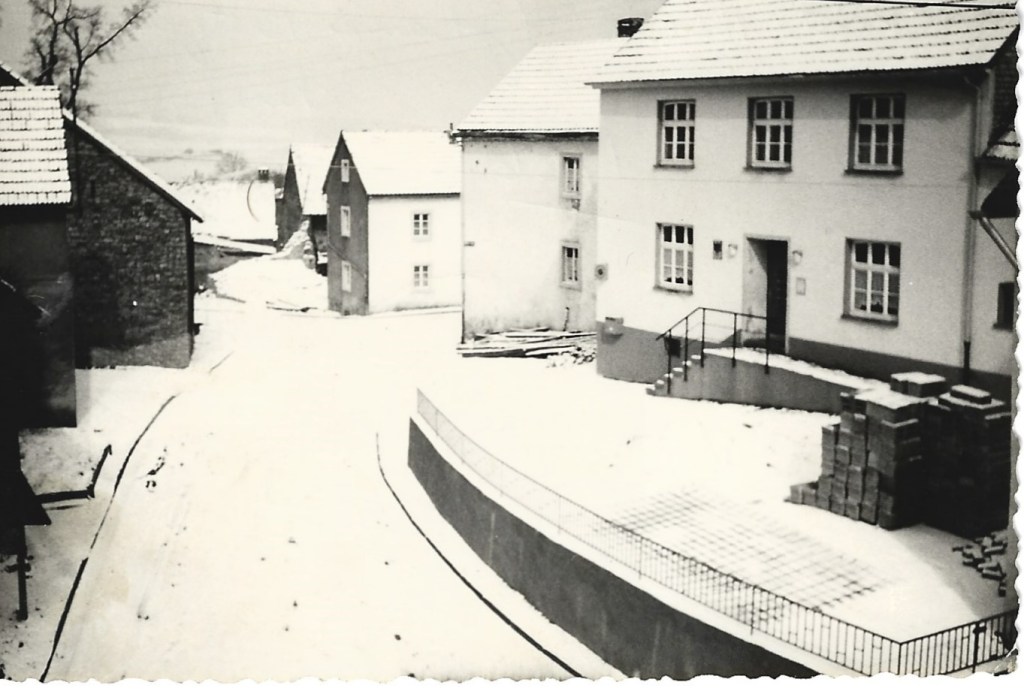
I have a document entitled Family Peetz in Dollendorf , which was put together by friends of Cindy and Larry and later translated for me by a German illegal alien acting as a nanny in the states and who needed a gall bladder removal and so traded me for the work. It takes the family reliably back to 1627 to a man named Wilhelm Peetz- Reckels. He may have been descended from a man named Johann Peter Gierlichs born in Dollendorf in 1599. As for a surname, there is a notation at the bottom that reads: “ In conclusion, it was established that the origin of the name Peetz was presumably lost in the Thirty Years War. Pietzen House was the name given at the end of the 1600 through inheritance, marriage or purchase. First of all, the house of Gierlich then in the second half of the 1700’s in the house of Reckels-Schellens. Then in 1629 the name Pietz or Pietzger appears. There is some question of marriage of the descendants into the Gierlich and Schellen families.” At that time, there was no set name for families that lived out in the country. A set family name started for them at the end of century and came from the house name or place of origin. A man that moved into the original house of his wife went under her house or family name. His descendants then picked a family name. So, it seems likely that Johann’s ancestors lived in a house built by a man named Peter or Reckels and so we came to be known as Petershausen later shortened to Peetz. This is an image of the Post House in Dollendorf where Johann was born; this site was the original Pietzen house.
In Sweden and some other parts of Scandinavia, the names changed with each generation so a man named Max who was the son of Ole was Max Oleson but his child Steve would have been Steve Maxson. Fortunately for genealogists this stopped when they came to the new world. Copenhaver has several different possibilities and Tracy is very common in both England and Ireland.
As early as 1700 Peter Peetz-Reckels is identified as a sexton. The position of sexton was often handed down for generations and that appears to be the case here. His role in small parishes was to look after the grounds and building and often serve as caretaker and gravedigger. In some localities, he was also a political figure. We know this passed down at least as far as Heinrich, Johann’s father who was listed as sexton in 1858. Along the way, it appears that most of the family were either teachers or farmers. One early son, Michael, fought with Napoleon for six years and survived the march home from Russia. Later when the Prussian army switched sides he fought against Napoleon at Waterloo, was wounded in the arm and died two months later of complications.
In about 1870, the sons of the Heinrich Peetz family looked to emigrate to the United States. An older son, Wilhelm, and his wife came to the Detroit area and then lost contact with the family. It seems that he had at least one son but he died soon after coming and no one in the family, including Johann ever saw or heard from him again. Some of this story is confirmed by a letter between Johann’s brother Peter, who remained in Germany, and Catherine after Johann’s death.
The second son, Johann Peter emigrated in 1883 with his wife and small daughter and brother-in-law Nicholas Treinen. They came to New York City and started a brick building service. Unhappy with city life they moved to Marysville, Kansas in 1885 and then homesteaded thereafter on a ranch ten miles SW of Fort Sidney and seven miles NE of what was to become Peetz, Colorado. At the time, it was a vast endless prairie which was broken to grow crops by horse drawn single bladed plows. Johann’s oldest son Peter, our grandfather John Sr.’s brother, worked on his father’s farm and then applied for his own homestead grant. This land eventually became the land upon which the town of Peetz, Colorado was established. There is some confusion as to the founder as a later amateur historian named Clark Fuller, who wrote about the panhandle of Nebraska, refers to Johann by his middle name of Peter. However, in later life the city founder, Peter recounted his story for several newspapers.
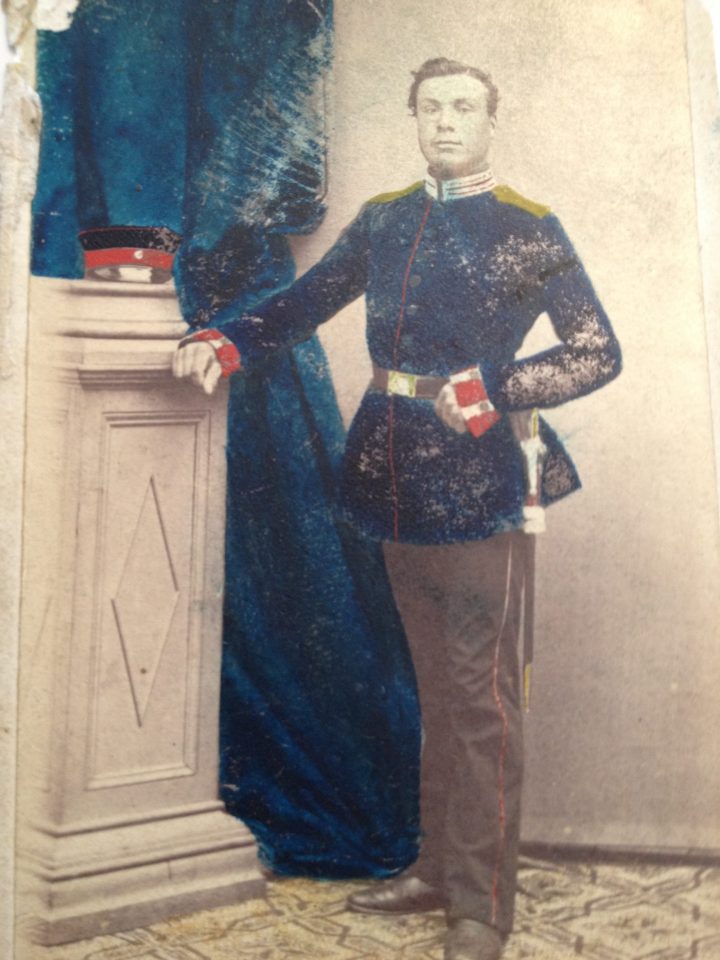
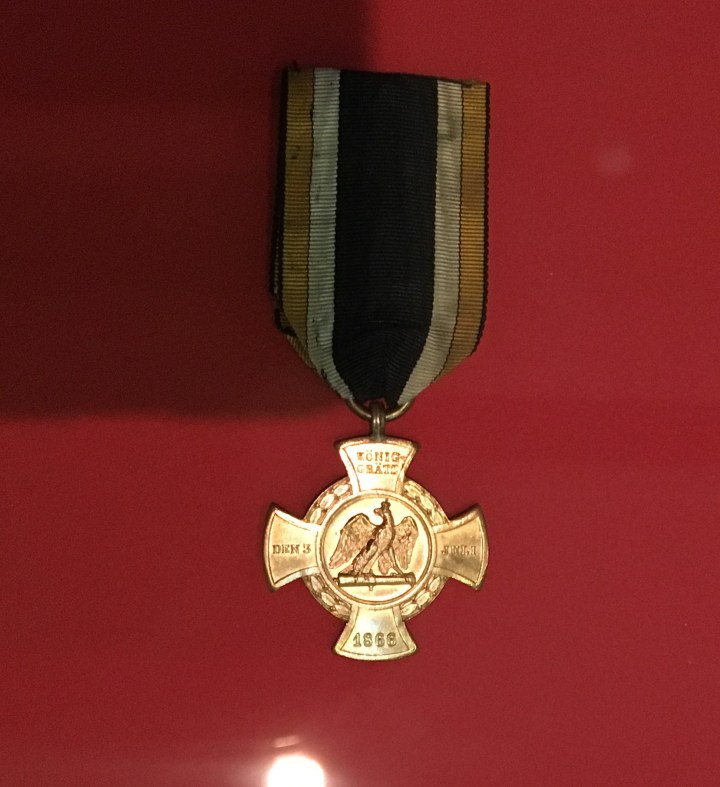
Prior to leaving Prussia, Johann had a distinguished record in the military. Some of this we know from his military passbook which is a small paperback book with both discharge papers and military record combined. It shows that he was in the active duty military two different times, once for the war between Austria and Prussia in 1866 and again in the Franco-Prussian war of 1870-71. He kept a diary of the first war and was awarded a medal for service. The medal, a Koniggratz Commemorative Cross, can be seen one of the photos taken in his military uniform. It was awarded by King Wilhelm I of Prussia to officers, NCO’s and other military personnel for active duty in the Battle of Koniggratz which took place on July 3.1866 and was not only the most decisive battle of the war but involved the largest number of troops in any battle in Europe up until that time. The battle ended with one of the highest number of casualties for a major battle with the Austrians and their allies losing 44,000 men killed, wounded or missing with another 22,000 taken prisoner. The Prussians lost 360 officers and 8900 men. The medal is of bronze taken from the Austrian cannons. Johann’s medal is missing.
Picture taken before first campaign
Picture taken after first tour as he is wearing the medal and a photo of medal from War Museum in Berlin.
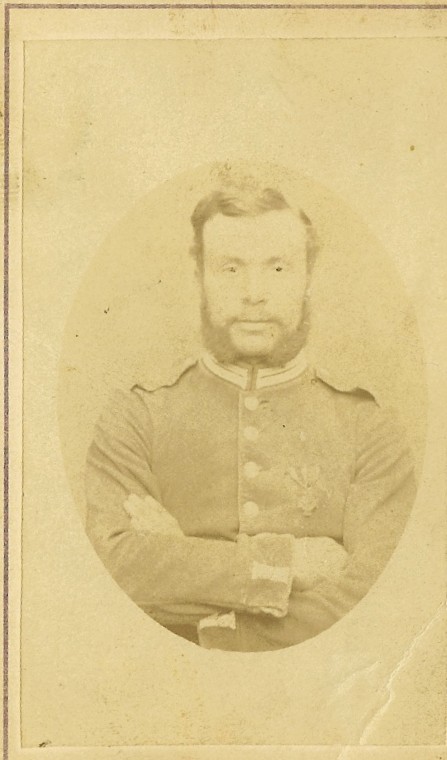
Whether he was drafted or enlisted in the military is unknown. At that time, all the major countries of Europe except Great Britain had extensive programs to draft young men for their many wars. Prussia had an additional law that allowed them to keep their returned soldiers in a reserve capacity subject to call back from age 17 until age 45. The German Army had four classifications of military service; Active, Reserve, Landwehr, a regional militia and the Landstrum, a Home Guard. This gave them an army of trained soldiers second to none and accounted for their rapid expansion in the last half of the nineteenth century.
Johann was given a Certificate of Conduct that states: The infantry soldier Johann Peetz, 5th Company of the Royal Guard Infantry Regiment, born July 7, 1844 in Dollendorf, district Schleiden, Administrative Dept. of Aachen is certified to have GOOD conduct in his service time, according to the military ID that has been given to him today. He was a courier. H has been punished once in his serving time: June 18, 1867 with 24 hours’ arrest in the caserne for leaving the caserne in a dress that was against the prescriptions. Berlin, July 30, 1867 v Witzleben Captain and chief of the Company.
This Von Witzleben is an ancestor of the General Von Witzleben who had participated in an attempt on Hitler in 1944 and was executed.
The Personal Statistics page of his soldiers book lists his date of birth and his height in Zolls at 7. I suspect this is a misprint and they meant 70 which would put him close to 6 feet tall. His faith is Catholic; occupation: carpenter, and father’s occupation as farmer. He entered the army on October 16, 1864 as No. 308 of Registration., which I suspect means he was drafted. He would have been twenty years old at the time. He was discharged to the reserve on July 31, 1867.
He was awarded the Memorial Cross 1866 for the Battle of Koniggratz. During the war, he was involved in several of the army campaigns: June 28, 1866 Battle of Soor; June 29, 1866 Battle of Koniginhof; and the definitive battle; July 3, 1866, Corp Battle of Koniggratz.
The Guards Corps was a corps level command of the Prussian Army from the 19th century until WWI. The Corps was headquartered in Berlin with units in nearby towns of Potsdam, Juterbog, and Doberitz. Unlike all other Corps of the Imperial Army, the Guards Corps did not recruit from a specific area but from throughout the Prussian empire and in “the Imperial Lands” of Alsace-Lorraine. The 4th Queen’s Guards Regiment was an infantry regiment, established in 1860 in Koblenz and composed of soldiers primarily from outside of the Berlin region. Johann was listed at various times as a courier or a commando. He describes his wartime activity in a long diary and seems to have acted as a courier at the end of the battle. He returned to Dollendorf at the end of the war to resume his life there.
In 1870, Prussia, having solidified its position as the leader of the German states, set out to further dominate Europe and establish an empire. On rather flimsy grounds the two major European powers, France and Prussia with its allied German states and confederations, went to war. The war, henceforth known as the Franco-Prussian war went very badly for France and many believe was the harbinger of the later world wars. Johann was called back into the service and this time is listed as a commando of the Guards Infantry Regiment, 2nd Battalion, Fifth Company and was involved in the invasion of France. He fought at the Battles of Saint Privat la Montagne, Beaumont, Sedan, and was at the siege of Paris from September 19, 1870 until January 28th, 1871. He was transferred to the Home-Defense on October 1, 1871 and discharged from the Home-Defense on November 5, 1878. It is believed that during the siege of Paris he was used as a spy, given his “dark” features and his knowledge of the French language. He was sent into Paris to gather information. He left no diary of this war but the only book he was known to value was a history of the war that was kept in the safe with his other significant documents. Unfortunately, the book is also lost.
The two wars he fought in were remarkably violent even for wars of the time. In the first, the Austro-Prussian war, the initial encounters were relatively minor battles but the final battle, at Koniggratz, was brutal with hand to hand fighting often following bayonet charges. This is the war that Johann documents in his diary although he skips many of the details. This battle has been called one of the most significant of the century in that it lead to the replacement of the Austro-Hungarian empire with the Prussian state as the main player in the German constellation of minor states. The old confederation of states that made up the German system and which featured both Austria and Prussia as equal partners dissolved. Prussia formed a new partnership with many if not most of the smaller German city-states and regions into a new German confederation. One of these city-states was Oldenburg, home to a family known as Bolke. I can find no history of those ancestor’s military involvement in the coming war but as conscription was fairly universal I suspect that they were part of the German-Prussian force that subsequently invaded France in 1871.
Johann was a member of an elite commando unit, that was a version of shock troops or SEALS today and so was often in the thick of the most intense of the fighting.
In the Franco-Prussian war, the second battle that he was involved in, at St. Privet, while a German victory, was a horrific slaughter on both sides. On the day of battle, at 5 PM, the entire Guards attacked uphill into massed French guns well protected behind stone walls. The French gunfire was described by the Prussian commander, Paul Von Hindenburg, later to achieve WWI and political fame in Germany, as “a hurricane” striking the Guards. Despite losing close to twenty thousand men, sometimes 80% of a battalion, the Prussian pushed the French back, likely due to French incompetence as much as to German bravery. The following morning, American General Philip Sheridan, Civil War hero and now an international observer, rode the battlefield with Chancellor Bismarck, and remarked on the “awful carnage, a sight sickening to the extreme”. The internment of the dead over the next few days in mass graves was said to haunt many soldiers for years. The French army retreated to Metz and Johann with the remaining Guards Corps wheeled to encircle Paris for a six-month siege.
The siege of Paris was a long and miserable affair. The Emperor of France, Napoleon III had been captured at the Battle of Sedan and the French government was defiant but in disarray. There really were two fronts, Paris and the countryside. The conditions around Paris were such that the two armies had frequent but short contact with few major battles. The French people and their army were starving and there was much interaction between individual soldiers with the Germans often trading their plentiful food for information. Because of his ability to speak French, Johann may well have been one of the many soldiers sent into Paris in civilian dress to obtain information. In other parts of France, the battles between more ardent French patriots and the occupying Prussians quickly turned into a bitter and sadistic war with cruel acts of resistance followed by brutal retaliation. It was said that there was no honor on either side. Eventually France capitulated and was so thoroughly humiliated that, combined with the savagery of the partisan warfare, the stage was set for two more wars within the next generations. Officially, the war ended in 1871.
This was an incredibly bitter war for both countries, with neither side forgetting the transfer of territory or the ferocity of the war in the outlying areas of France. While in Berlin, I came across a painting in the War Museum entitled: The Black Stain showing the world map in which the regions of Alsace and Lorraine are portrayed all in black:
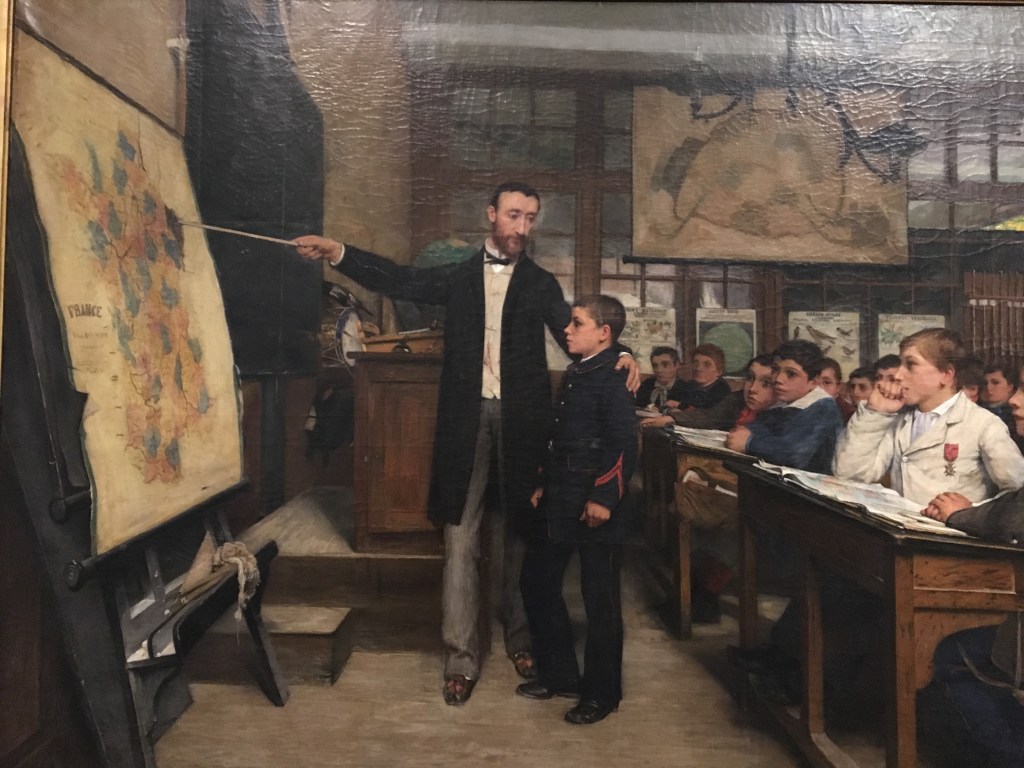
Johann was discharged but his military passport shows that he was called back for two short stints, each a month long in the summer of 1876.
Prior to the war, Johann was a carpenter and as third son would not have been in line to become a sexton. The rapid population growth of the last half of the nineteenth century in Europe meant that there was little land available. He was married at age 33 to a local girl, Maria Katherina (Catherine was also used in some correspondence) Treinen who was 22 years old. By then he had already been in the service once and was to be called back soon after his marriage for the Franco-Prussian war. Their first child Margaret was born in October of 1877 followed by a son Peter in February of 1879. They then had two daughters both named Anna Elizabeth, the first of whom died within six months of birth in 1880 and the second who died at two years of age in 1883. A son Franz was born in Dollendorf on June 1883 and died that same day. The next child Matthias was born in Marysville, Kansas on October 31th of 1884, indicating that Catherine and Johann had emigrated to the United States sometime between fall of 1883 and spring of 1884. They reportedly stayed in Kansas for a year and then homesteaded in Cheyenne county, western Nebraska where their next child John was born on July 8th, 1887.
Johann and Catherine left Germany with two small children for better economic opportunities. Several historical accounts of the area, offered by descendants of other contemporary emigrants, report an area markedly depressed by falling farm prices and an unwillingness by the leaders to change the situation. It would be almost another forty years, into the 1920’s before there was adequate sanitation or available electricity. A second reason often given for emigration was the frequent call backs to the military and the aggressive tendency of the government to use war as a policy means. This continued in Germany and in fact a cousin, Kornelius Peetz was to fight for and die in the German army of WWI.
Johann and family emigrated to the United States in 1883 with her brother Nicholas Treinen, a bachelor and a carpenter. They initially tried to work in Brooklyn, NYC but did not like it. Moving to the Catholic German community of Marysville, Kansas they settled down briefly. Both families, as Nicholas had now met and married Catherine Mahr, a fellow emigrant although from the neighboring Alsace Lorraine region, left to homesteaded land in western Nebraska. The homesteads were ten miles SW of Sidney and seven miles NE of Mercer Co, which was to become Peetz, Colorado. The land was “proved up” and completely assigned to Johann in October of 1892. Even though they applied for the land in 1885 they did not physically come to the area to stay until the winter of 1887. Once here they unloaded their belongings from a rail car onto a wagon and proceeded to the raw land, located on the SE quarter of Section 10, Township 12, North of Range 50 and west of the Sixth Principal Meridian in Nebraska in what was then called the South Divide. This was unbroken prairie and heavily grassed sod. They built their own wooden and brick homes, perhaps from prebuilt section imported from Kansas with them and set out “taming” the range. They built nice, albeit, small homes of stone and wood. Aunt Maggie recounts that she never lived in a soddy until she went off to teach school in other parts of Cheyenne County.
Two interesting stories come down to us about what life was like at the time, both from children and direct descendants of these pioneers. Nick Treinen supplemented his income by working part time for the railroad and it is likely that Johan did as well, especially given that most of his male children would make a career out of railroad work. Frequently the families would walk along the tracks hoping to find bits of coal that fell off the many coal trains that were passing through as well as the engines themselves which by now were coal powered. It is said that frequently an engineer could be induced to toss an extra bit out for the families of fellow workers along the way. Also, in a history of the town of Peetz, mention is made of the children attending school periodically, usually three months at a time, because “Mrs. Peetz wanted them to learn to speak English as they only knew German. Once they attended school, only English was allowed at home.” Aunt Maggie is listed as the source for this story. I can remember Grandmother Clara not wanting us to learn German.
Clark Fuller, in his book Pioneer Paths describes the region in the 1880’s as rough and still inhospitable. At the time, much of the land was open range for several reasons. The big cattle ranchers would often get their cowboys to file on the land and then buy the land away to consolidate into large ranches. In addition, many homesteaders, recruited by the railroad companies from among the poor of the east coast or even Europe would file on the land, come west with aide from the railroads and then fail miserably due to inexperience as well as the very difficult task of turning inhospitable high desert land into farmland. The railroad companies needed settlers to ship freight but desperately were trying to sell off the huge land grants that they had been given, every other section on both sides of the tracks, to recoup failing companies. Unfortunately, this land was and remains a high desert, with poor enough soil and little enough rain as to make it very difficult for even modern farming operations with modern irrigation systems and twenty-first century farming techniques, improved seeds and modified crops to make it financially viable cropland. The ranchers themselves went through many boom and bust cycles depending on the weather and beef prices.
Fuller writes: “Even before the hard winter of ‘85-’86 that finished most of the big cattlemen in the Panhandle, homesteaders had been coming in large numbers. The lure of free land in the west had long been strong but fear of Indians had held most men back.” In a letter from the Dollendorf family to Johann in 1897 the one question asked first was about safety due to the Indians. Fuller continues: “For a time the ranch men, who had pioneered the way, braving Indians and other hazards to open the country withstood the flood and struggled to hold on. Most of the newcomers were farmers and the cattlemen knew that eastern farming methods would never work on the grassland plains…But for every “granger” who starved out and gave up, a dozen more seemed eager to take his place. The richness of the earth, the wonders of the climate, the low price of the land, all were magnified in eloquent descriptions aimed at the land-hungry poor. ( by the railroads.).. in time the plowman won.” Many of the remaining homesteads were cowboys who, faced with the failure of the cattle ranches, filed on the best land along water sources, intermarried with the newcomers and settled down. In other books about the west settlement, there is reference to a continuation of the Civil War with many of the ranchers and cowboys being Southerners and many of the farmers and lawmen originating from the North. By the 1880’s most of the farmers were new Americans like Johann.
Sidney became the largest town and the center of the region. It was founded as a railroad town to service the railroad companies and their workers and then in 1876 had the good fortune to become the jumping off spot for prospectors heading North to the Black Hills gold fields. Its ready access by rail and its location along water made it an ideal site for the US government to build a military post to protect the railroad and miners from the Indians whose land they were taking. This combination of relatively well paid, lonely soldiers and railroad workers, gold and time away from home was a natural to create the community that in the late 1870’s and 1880’s was known as the “Toughest Town on the Tracks”. Again Fuller: “Sidney’s mushroom growth had brought hordes of lawless men of every stripe into town. For several years- until law and order had time to catch up with the frontier- the place ran wide open. With a bar in every hotel, restaurant, billiard parlor and dance hall, there were said to be eighty-seven places where liquor could be purchased. Even the drug and grocery stores sold it. With cowboys, bullwhackers, muleskinners, and soldiers whooping it up around the clock for weeks on end, it is not surprising that by 1882, nearly two hundred people were buried in Sidney’s boot hill. Some had been killed by Indians, most in drunken brawls; a few had even stretched a rope.” In 1882, the great bullion robbery took place involving a crooked sheriff, a railroad detective known as Whispering Smith, and famous gunfighters.
Over the next twenty-five years, from 1885 until 1910, the combination of a growing family oriented farm community, the bust of the South Dakota gold fields, and the general American economic growth, produced a developing middle class which replaced this wild west culture with a stable agrarian small town. Religion was a big part of the transformation. This was the community into which Johann and Catherine brought their young family.
There was only a modest formal religious presence in the area, unlike in Marysville, where the strong Catholic German community served as a magnet for immigrants. The Sidney parish of St. Patrick’s had only been given a resident pastor in 1883 and the first recorded baptism was dated November 4, 1886. Twelve separate missions, outreaches of the parish, were recognized and services were held in individual homes of the predominantly German Catholic population. Father Anton Link arrived in 1913 and determined to build a church. Stone was quarried from the surrounding hills and excavation done by the local parishioners and the church cornerstone laid in 1913. One of the main workers must have been a young John Peetz, Sr. who would have been 26 years old. At least that is what we have been told accounted for his name beneath the stained-glass window of St. Patrick. Interestingly Father Link must have had some family money as he paid for the construction of a boy’s school, St. Charles, out of his own pocket before it was combined with the girl’s academy, St. Patrick’s, which was built in 1916. St. Patrick’s Academy itself was originated as a boarding school for Catholic schoolgirls in the region and we, as children in the 1960’s, often had babysitters or live in nannies who were from as far away as Colorado.
Johann did not live to see most of this. He died in 1897 after being treated for a lengthy time at St. Joseph’s Hospital in Omaha for difficulty swallowing. Dr. Dwaine Peetz Sr. has looked into the medical records and thinks this could have been either esophageal or gastric cancer. Gastric cancer was one of the leading causes of death other than trauma at the time. Aunt Maggie, who was a young woman of twenty and had been sent to Omaha as a help to her father, was sent by him to Marysville, Kansas to stay with relatives as Johann did not consider it proper for a young and unmarried woman to stay alone in Omaha, even to care for him. Catherine at the time had six children under the age of 18 at home, was pregnant with Aunt Mary and was running the farming operations.
Once Johann died, the running of the ranch fell to Catherine and the surviving children. Catherine at the time was 42 years old, just delivered of her seventh child, not including four previous children who died at birth or shortly thereafter, and relatively new to the United States. Very little is recorded about her. She lived on the homestead during the week and came to town, on horse and buggy, a ten mile journey on dirt roads, whatever the weather, for mass and family visits on the weekend. She combined this with shopping for groceries and essentials and then returned to the ranch on Sunday. We have some pictures of her in later life which are not flattering and in which she s not smiling. She was to remain a widow for 43 more years.We know that she sold the homestead land along with a quarter section that Maggie homesteaded and used the money to purchase a small house/business on the corner of the lot which housed the new St. Patrick’s Church. She lived there until her death in 1949 along with her children: Maggie and Mary, her eldest and youngest, both spinsters as well as Mathew, her son who was disabled and wheelchair bound for the last 29 years of his life by his work on the railroad.
Catherine was a sturdy German woman, strong in her faith and love of family. Very little is recorded and she herself left almost no written record. Aunt Katherine Moore remembers her as stoic but kind. She told me that the children of Clara and John Peetz would attend St. Patrick’s school and then go over to Grandmother Catherine’s small store next to the church until their father would come to town to pick them up. She remembers a ready supply of cookies and home-made bread with jelly but very little conversation and we can speculate how fluent in English Catherine was. None of the children were fluent in German by the fiat of John and Clara who were very conscious of the anti-German feelings of many people in the first half of the century. This arrangement continued even into high school until John Jr, her younger brother was able to drive them home. Of course in the 1930’s girls didn’t drive.

